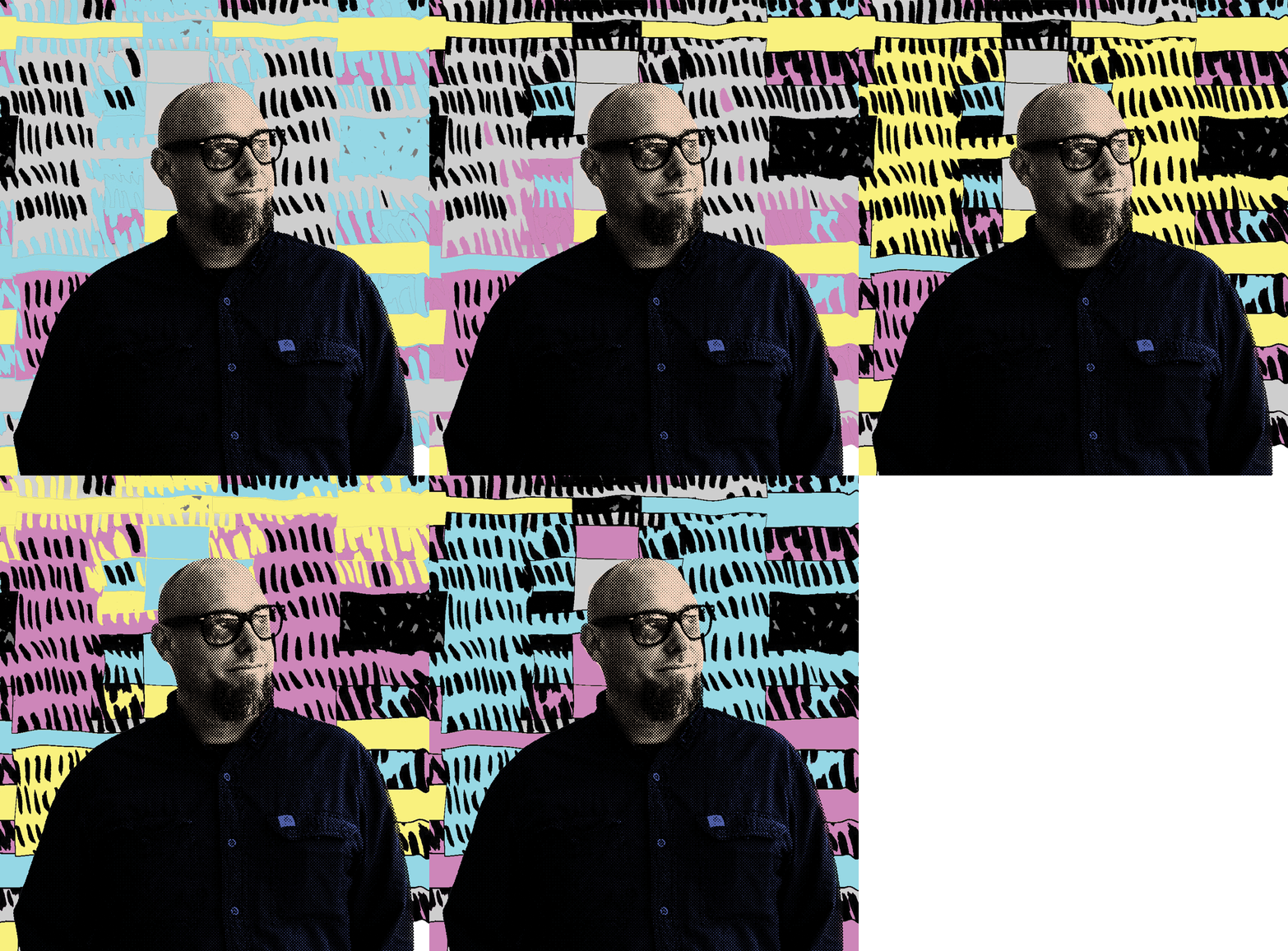
Jeremy Scidmore
Artist Statement:
Jeremy Scidmore is a multidisciplinary artist working across glass, neon, sound, and computational media. His practice examines systems of production, signaling, and cultural infrastructure, with particular attention to the hierarchies embedded within commerce, capitalism, and the built environment.
Rooted in industrial craft traditions, Scidmore employs glass and neon as both material and cultural artifact. Neon functions as a language shaped by economies of attention—historically tied to advertising, nightlife, and urban spectacle—where visibility is structured by capital, access, and power. Through this lens, his work interrogates how commercial hierarchies determine what is seen, what is valued, and how meaning circulates in public space.
His installations often operate as counter-sites within these systems, drawing on the political theory of agonistic pluralism, in which democratic space is defined not by consensus, but by sustained tension between competing perspectives. Rather than resolving conflict, the work stages it—using material contrast, spatial intervention, and symbolic dissonance to expose the instability of dominant narratives and the conditions under which they are produced.
Extending beyond object-based practice, Scidmore engages computational and networked media as parallel systems of production. His generative and web-based works utilize live data, algorithmic processes, and temporal structures to reveal patterns of accumulation, volatility, and fragmentation within contemporary information economies. Here, data is treated as a material shaped by the same forces of extraction, distribution, and control that govern physical production.
Across both physical and digital domains, his work explores the tension between structure and emergence, authorship and system, consensus and conflict. By constructing frameworks that exceed direct control—whether through the behavior of heated material or the logic of code—Scidmore foregrounds process as a site where meaning is negotiated rather than fixed.
Operating between studio practice, public space, and technological systems, his work situates itself within the broader conditions of contemporary life, where material, signal, and power are inextricably linked.
BIO:
Jérémy “Jem” Sçidmore earned a BFA at the School of the Art Institute of Chicago and later returned to SAIC to study Arts Administration and Policy. While in Chicago he became committed to the idea of art as activism, developing and advising an array of community-based programs for underserved neighborhoods. His concurrent personal art practice has covered a wide array of glass media (neon, hot glass, kilnforming, glass printing), as well as installation, video, and sound. He continues to balance these studio-based explorations with community activism through arts advocacy and teaching.
In 2000 Jeremy served as a founding board member of Cooperative Image Group (CO-OP), the brainchild of fellow arts activist, and co-conspirator Michael Bancroft. Realizing a need for both public art and after-school arts programming in the high crime neighborhood of Humboldt Park, Chicago IL, CO-OP created a youth Drop-In center for the collaborative creation of public art. Other programming included a youth managed cooking show, a youth managed screen printing business, collaboratively developing community vegetable and sculpture gardens throughout Chicago, and organizing dozens of public murals throughout the city.
In late 2001, he joined Chicago Hot Glass Inc. (CHG), a public access glass arts education studio on the west side of Chicago. While at CHG he oversaw all aspects of the business, including curriculum development and training of new faculty and staff. Recognizing the needs for youth STEAM education and job availability in CHG’s west side neighborhood, Cooperative Image Group and CHG merged resources to institute a new program called GlassWorks designed to educate disadvantaged youth in crafts based art.
As an educator, he has also developed and maintained diverse curricula in a variety of academic and nonprofit arts education organizations such as Chicago Hot Glass, the School of the Art Institute of Chicago, Archeworks, Bullseye Glass Company, the Ox-bow School of Art and Artist Residency Program, and the Crucible. This range of experience has given him a unique combination of administrative skills, technical studio arts knowledge, curriculum design, and public arts management. Additionally, he has mentored and trained scores of artists, faculty, studio assistants, youth teachers, interns, and student workers many of whom have started their own private arts studios or became faculty or arts administrators in arts organizations around the world.
Scidmore is currently based in Dallas/Fort Worth where he is Studio Technician and Faculty in the Glass Studio at the University of Texas Arlington’s Art and Art History Department. Additionally, he has been an instructor, lecturer, and adviser at a range of academic, nonprofit, and for-profit institutions including Google, Solar City, The Crucible, Chicago Public Schools, Street Level Youth Media Group, School of the Art Institute of Chicago, University of Illinois Urbana, Pilchuck Glass School, Pittsburgh Glass Center, Public Glass, Ox-bow School of Arts and Residency, California College of Arts, Bullseye Glass Co., The Art Institute of California, Urban Glass, and North Land Creative Glass (Scotland).